Written by Jay Chauhan | Certified Development Practitioner (API) | Licensed Builder | Master of Property | BCon Management (Hons) | BCom Accounting | Member, Master Builders Association NSW | Member, Australian Property Institute | April 2026
Renovating, extending or rebuilding your home in Sydney is one of the most significant financial decisions you will make, and one of the most complex. There are multiple stakeholders, competing opinions, planning and construction risk, and very little guidance on how to approach it the right way. Most people begin without ever asking the most important question: will this project actually put me financially ahead? A feasibility study is how professionals answer that question first, before a single dollar is committed.
Key Takeaways
- A feasibility study is the cheapest way to establish whether your project is achievable and financially worth doing — before any money is spent on design or construction
- It applies to all residential project types, from home renovations to knockdown rebuilds and duplex builds
- The report covers planning controls, comparable sales, site constraints, total project cost and ROI in a single assessment
- Professional developers always run feasibility first — most homeowners skip it entirely
- ROI Projects combines development management and builder expertise to deliver feasibility through to construction under one roof
What Is a Feasibility Study, and Why It’s the Smartest Way to Start Your Project?
A feasibility study is an assessment of your project before design or construction begins. It assesses whether what you want to do is achievable, given your site, approval constraints, construction complexities, value add potential and return on investment.
In commercial property development, no serious developer would commit to a project without one. The same logic applies to residential projects, whether you are adding a second storey, converting a home for multigenerational living or knocking down and rebuilding.
It Is Not Just for Developers
The word feasibility tends to conjure images of large commercial developments and thick reports written for boardrooms. That is not what we are talking about here.
A residential feasibility study is a straightforward, affordable assessment built around your specific property, your goals and the Sydney market. It gives you the critical decision-making information upfront, the kind of clarity that used to be available only to professional developers.
It guides everything that comes after: design, approvals, construction. You still get the quality build at the end, a feasibility study simply makes sure it is genuinely value adding.
What It Actually Tells You
A feasibility study is presented in a report which is a collection of research and investigation into all the critical risk factors that will impact your project.
Market analysis is done to establish value potential, unique suburb price movement, and demographics to understand demand source. Planning and approval analysis reviews LEPs, SEPPs and DCPs that apply to your property which ultimately impacts design. Site and NCC analysis identifies the compliance issues and best build methodology given existing structure, services and site constraints.
All of the aforementioned is analysed against the client’s brief to establish best strategy. In most cases sketch plans are also included.
Total project cost is estimated which gives clarity on all costs associated with the project, not just the build.
Lastly a return on investment calculation is performed to establish whether the project stacks up financially or not.
And of course the greatest benefit is all this information is available at the very start before funds and emotions are tied up in a design and builder engagement.
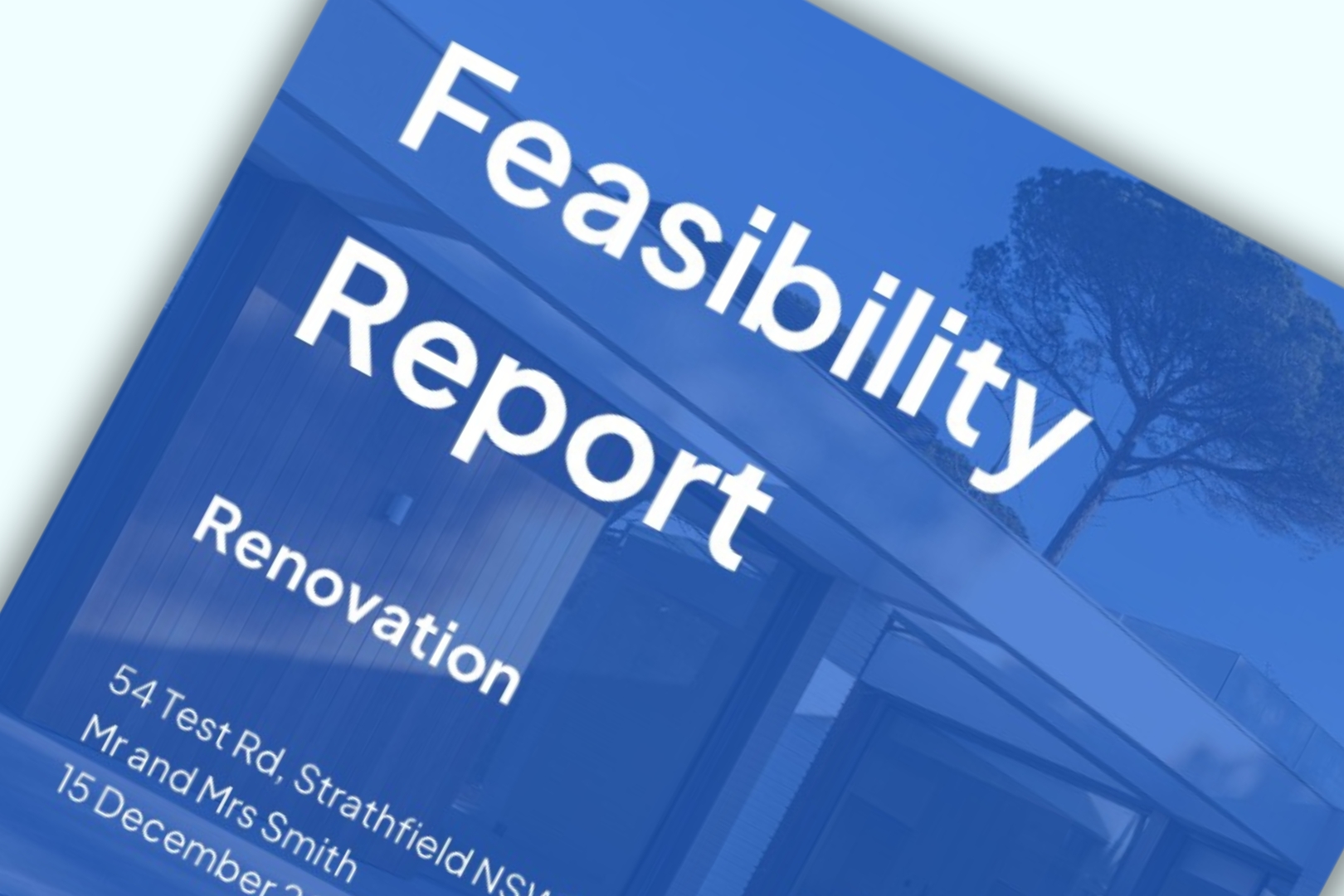
📷 Feasibility report snapshot — executive summary extract (F1)
Which Sydney Projects Actually Need One?
A feasibility study is not a one-size-fits-all document. The questions it answers and the risks it surfaces are different for every project type. What drives value for a duplex is not the same as what drives value for a multigenerational renovation. What follows is how a feasibility applies to each of the six project types we work on at ROI Projects. In every case, the goal is the same: solve the client’s problem while maximising the value add. Budget is almost always the biggest limiting factor, and it is our expertise to get that balance right.
Renovate My Home
For a home renovation or extension, the feasibility is largely site-driven. Your block determines what is physically and legally possible, including whether going up is more practical than going out, and what planning controls permit. One of the most common issues identified early is a significant contrast between proposed new work and the existing structure. A cosmetic renovation that sits awkwardly next to original finishes, or an extension that does not integrate with the existing build, can undermine both the liveability and the value of the property.
Creating a Multigenerational Home
Multigenerational living arrangements come in two forms, attached secondary dwellings and detached secondary dwellings, and the difference matters more than most people realise. The value-add potential and construction complexity of each option are significantly different, as are the planning approval pathways. Beyond the physical options, the assessment examines whether truly separate living spaces are achievable within the constraints of the site and the planning controls. Small preferences such as having a second kitchen can have very significant impact on approval pathways and an even bigger impact on cost.
Renovating an Investment Property
For investment properties, timing is everything. The opportunity cost of renovation funds is a key variable that is often overlooked. If you are planning to hold the property long term, a well-executed renovation can deliver strong returns. If the timeline is shorter, the approach changes. Equally important is a clear understanding of tenant demand in the specific suburb, what tenants in that market actually pay a premium for. In most cases renovating for a tenant is the focus for immediate income improvement, but come the time to sell, an owner occupier product will get a higher price. The expertise comes in being able to renovate to appeal to both markets.
Downsizing Smart
Downsizing is rarely as straightforward as it appears. The first question the assessment asks is whether relocating is actually the right answer, or whether modifying the existing home to suit changing needs, including an age-friendly layout or even a multigenerational configuration. What makes a good downsizer product is often the same thing that makes a good first home, a smaller, low-maintenance property that is safe, functional and well-located. Understanding that overlap is what creates genuine value in this project type.
Knockdown and Rebuild
The first question a knockdown and rebuild feasibility answers is whether to rebuild at all. In some cases, a renovation delivers comparable outcomes at significantly lower cost and risk. In other cases a rebuild is the one that delivers the biggest value add, albeit coming with a larger total investment. When a rebuild is the right path, getting the product right for the market is critical. The design, configuration and specification all need to be analysed against what buyers in that suburb will actually pay for.
Building a Duplex
The starting point for any duplex feasibility is understanding why you want to build one, because the answer shapes everything. Are you looking to release equity from your existing land, building for profit through a sell-down strategy, or holding both dwellings for long-term income? Each scenario has a different financial profile and a different risk threshold. From there, the focus turns to designing the right product for the market. The relationship between construction cost and end value is tighter in duplex development than almost any other project type.
What Is Inside an ROI Projects Feasibility Report?
Client Brief
Every feasibility report starts with understanding what the client is actually trying to achieve. That means pinning down the non-negotiables, what they want and whether they are willing to trade some of those requirements if it means a better financial outcome. It means understanding the budget, because we work backwards from that figure, or advise early if it is not sufficient to make a meaningful impact on value. And it means understanding the timeframe, whether this is a forever home, an investment property held for the next fifteen years, or something in between. The answers to those questions shape everything that follows.
Demographics
Demographics tell you who the future owner or tenant of the property will be, and where demand for the finished product will come from. Without that understanding, you risk building the wrong thing for the wrong market, regardless of how well it is designed or constructed.
Comparable Sales and Rent
Comparable sales and rental data establish the end value of the finished product. This is the most important number in the entire assessment, because without it you have no way of knowing whether you are at risk of overcapitalising. Once the ceiling value is established, everything else, the design, the specification, the construction budget, works backwards from there.
The Market
The market section looks at how the specific suburb performs, its capital growth rate, price volatility and where it sits in the current cycle relative to broader Sydney. A project that stacks up financially in a high-growth suburb with strong demand may produce a very different outcome in a suburb with softer conditions, even if the construction cost is identical.
Highest and Best Use
Highest and best use considers the most valuable use of the property that is physically possible, legally permissible and financially feasible.
This is the strategic heart of the assessment. If a property has the potential for townhouse development, a renovation is unlikely to add meaningful value because the market is already pricing the land for its redevelopment potential. A more nuanced example: a detached granny flat may seem like the obvious solution for a multigenerational living brief, but if the market in that suburb places a strong premium on backyard space, the value-add potential of that option may be poor. Understanding highest and best use ensures the project you proceed with is one the market will reward.
Existing Property and Structure
This section identifies the physical characteristics of the site, including services, existing building construction, site coverage and access. These are the factors that directly drive construction cost and methodology. Two properties with identical plans can have very different cost profiles depending on what is already on the ground.
Planning Controls
Planning controls determine what is legally permissible on the site. This section identifies the major controls affecting the proposed works, including zoning, overlays, setbacks, floor space ratio and height limits, and assesses the available approval pathways, whether DA, CDC or Strata. Where compliance with certain controls would be disproportionately costly, that is flagged early.
Construction Issues and NCC Compliance
This section identifies the building classification of the property and the National Construction Code provisions that are likely to be difficult or costly to comply with for the proposed scope. It also identifies site-specific construction issues that will affect cost, including access constraints, structural issues and programme. These are the variables that most cost estimates miss, and the ones most likely to produce an unexpected bill mid-project.
Analysis
All of the above factors are assessed against the client brief to identify the best approach. The site, the planning controls, the market data and the construction considerations are weighed together to determine what is viable, what represents the best financial outcome, and what aligns with what the client is actually trying to achieve.
Results
The results section summarises the risks of the project and identifies the value-add potential. For owner-occupiers this is expressed as estimated market value uplift. For investment properties it includes projected rental income increase. The recommended path is stated clearly, along with what was ruled out and why.
Total Estimated Cost
The total estimated cost is a full project cost scenario, not just the construction figure. It covers design, approvals, consultants and construction, giving a complete picture of what the project will require financially before a commitment is made. For more on why total project cost matters more than focusing on any single cost line, and why value matters more than price, see our renovation costs article.
📷 Feasibility report snapshot — total estimated cost extract (F3)
ROI
The return on investment section quantifies the financial performance of the recommended path. For owner-occupiers, this is expressed as value add divided by total project cost. A project that costs $500,000 in total and increases the property value by $540,000 produces a return of 8 percent on funds invested. That is a strong outcome, and one that requires getting the brief, the design and the budget allocation right from the start.
For investment properties, the measure is annual rental income increase divided by total project cost, expressed as a percentage per annum. A $200,000 renovation that increases annual rent by $11,000 produces a 5.5 percent per annum cash return on the capital deployed, which compares favourably against most alternative uses of that capital. To understand what returns are realistic for your project type, see our case studies.
Why Feasibility Has to Come Before Your Designer or Builder
The Mistake That Costs Months and Money
The most common path a Sydney homeowner takes looks like this: an idea forms and they go straight to a designer or a builder, plans are drawn up, approvals are sought, and somewhere in the to-ing and froing between design, consultants, council and the builder the original brief gets lost. In many cases the approved design comes back over budget. In others, the project stalls mid-process or gets significantly watered down.
The problem is not any one participant. The problem is that nobody at the start of that process is focused on whether the project makes financial sense before the costs begin to accumulate. By the time that question surfaces, months have passed and the answer is harder and more expensive to act on.
- Project risk assessed
- Value add potential quantified
- Total project cost estimated
- ROI determined
The Two Steps Professional Developers Always Use — And Most Homeowners Skip
Every professional property developer follows the same sequence for any project where profitability and delivering a strong brief both matter. First, a feasibility study to test viability. Second, Design Development and Value Engineering to translate that feasibility into a design that holds its value all the way through to construction.
DDVE is the process of refining a design until it satisfies as many requirements as possible simultaneously: the client brief, planning restrictions, construction efficiency, cost and end value. It requires knowing what things cost to build, how they are built, and what the market will pay for them. That combination of knowledge is what keeps a project on track financially from design through to handover.
Most homeowners skip both steps. They go straight to a designer and hope the builder’s quote comes in on budget. It rarely does.
View all ROI Projects services ›
Builders and Development Managers — That Combination Is Our Difference
A builder and a development manager are two different skill sets. A builder knows how to construct. A development manager knows how to assess a project commercially, assemble the right team, and keep the financial outcome in focus across every stage.
ROI Projects brings both skill sets to every project. That means the feasibility we produce is not just a construction cost estimate. It covers planning, market value, financial return, site constraints and total project cost in a single assessment. And because we are also a licensed builder, our involvement does not stop at a report. We can take the project from feasibility through design, approvals and construction to handover.
That end-to-end capability, underpinned by both development management expertise and builder knowledge, is what makes the difference between advice and a result.
Frequently Asked Questions
How is ROI Projects’ feasibility report different from a builder’s or designer’s?
A builder’s estimate focuses on construction cost. A designer’s brief focuses on what the client wants to build. Neither starts from the question of what the market will support or whether the project will increase the value of the property. ROI Projects approaches feasibility as development managers first, which means the assessment covers planning, market value, financial return and total project cost in a single report, followed by the ability to deliver the project end to end as a licensed builder.
How much does a feasibility study cost?
A feasibility report usually represents between 0.5% to 2% of project budget. Contact us for a fee specific to your project and property.
How long does a feasibility study take?
Typically two to four weeks, depending on the complexity of the project and the scope of the assessment.
What information do I need to provide for ROI Projects to do a feasibility report?
To get started we need five things: your project type, your specific requirements, your overall timeframe, your budget, and any local knowledge that you think we should know about. You do not need drawings or any other documentation. Complete an online form which takes about 5 to 10 minutes and that’s it.
Where can I find more information about how a feasibility works for real projects?
Visit our case studies page for real examples, or download a sample feasibility report to see the format and content firsthand.